

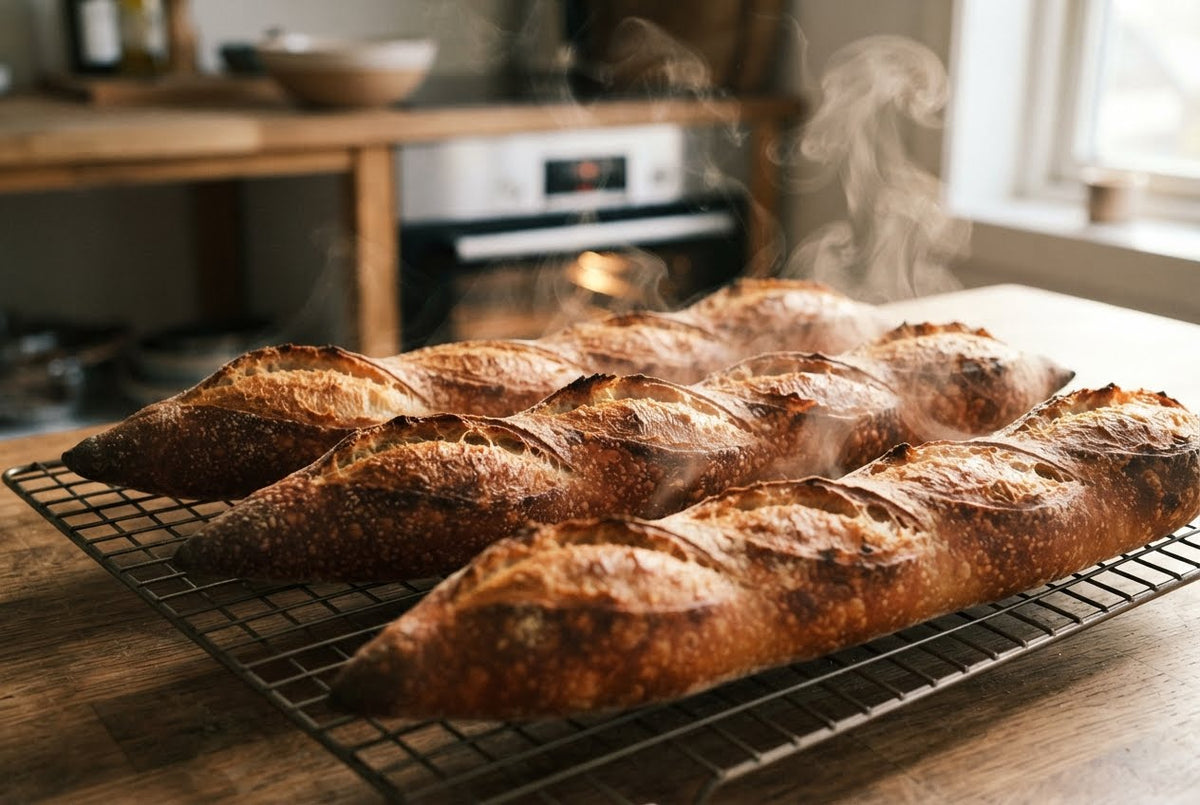
24 Hours to Perfection: The Ultimate Pizza Steel French Baguette
Brian Wolter
3 Baguettes
30 minutes
23 minutes
612
French
Bread
This 24-hour slow-fermented French baguette recipe leverages the high heat conductivity of your pizza steel to deliver an authentic, deeply flavoured crust with a light, airy crumb. By using a combination of room-temperature bulk fermentation and a cold retard in the fridge, the dough develops complex flavours without needing a complex starter or poolish.

Ingredients
- 500g Wheat flour. Preferably Tipo 00 or another type of wheat flour with a protein content of at least 11 per cent.
- 360g Water. Lukewarm (approx. 20–22°C).
- 11g Fine salt. Essential for structure and flavour.
- 1,5g dried yest/instant yeast. Approx. ½ teaspoon. Less yeast allows the long ferment.
Instructions
Step 1: The Mix and Autolyse (Day 1 — Hour 0)
In a large mixing bowl, whisk together the flour and yeast.
Pour in the water and stir with a dough scraper or the handle of a wooden spoon until a shaggy, messy dough forms with no dry flour remaining.
Cover the bowl with a damp tea towel or a plate and let it rest at room temperature for 30 minutes. This is the autolyse phase, which kickstarts gluten development naturally.
Step 2: Incorporate Salt and Stretch-and-Fold (Day 1 — Hours 0.5 to 2)
Sprinkle the salt evenly over the dough
Wet your hands slightly to prevent sticking. Reach down to the bottom of the bowl, grab an edge of the dough, stretch it gently upwards, and fold it over the center. Turn the bowl 90 degrees and repeat. Do this 4–5 times until the salt is incorporated and the dough feels tighter.
Cover and rest for 30 minutes.
Repeat this stretch-and-fold routine twice more, spaced 30 minutes apart (3 sets total over 1.5 hours). With each set, you will notice the dough transforming from a sticky mess into a smooth, elastic sheet.
Step 3: Room Temp Bulk Fermentation (Day 1 — Hours 2 to 12)
Cover the bowl tightly with a reusable dough lid or cling film.
Leave it to ferment on your kitchen counter at room temperature (around 19–21°C) for 10 hours (typically overnight). It will double in size and show small bubbles on the surface.
Step 4: The Cold Retard (Day 2 — Hours 12 to 22)
Move the covered bowl straight into the refrigerator for 10 to 12 hours.
Why this matters: The cold environment slows down yeast activity but allows enzymes to continue breaking down starches into complex sugars, giving you that iconic French bakery aroma and a gorgeous, blistered crust.
Step 5: Divide and Pre-shape (Day 2 — Hour 22)
Gently tip the cold dough onto a lightly floured work surface, taking care not to knock out too much air.
Use a bench scraper to divide the dough into three equal portions (approx. 290g each).
Pat each portion gently into a rough rectangle, fold the top third down to the middle, and the bottom third up (like an envelope). Roll lightly into a loose log.
Cover with a floured tea towel and let them rest for 20–30 minutes to relax the gluten.
Step 6: Final Shaping and The Final Proof (Day 2 — Hour 22.5)
Take a dough log and flatten it slightly into a rectangle. Fold the top edge down to the center and press the seam with your thumb. Fold the top edge down again all the way to the bottom edge, sealing the seam tightly with the heel of your hand to create surface tension.
Place both hands over the center of the log and roll it back and forth, gently moving your hands outward to elongate the dough into a 14–15 inch (approx. 35–38cm) baguette with tapered ends.
Dust a heavy linen baker's couche or a clean, sturdy tea towel heavily with flour. Create pleats (folds) in the cloth to support the baguettes sideways so they hold their shape and rise upwards rather than spreading flat.
Place the baguettes seam-side up in the pleats. Cover loosely and let proof at room temperature for 45 to 60 minutes.
🥖 The Pizza Steel Baking Setup
Because your pizza steel transfers intense heat rapidly from the bottom up, it functions just like a commercial deck oven, giving your baguettes an explosive oven spring.
Preheat: Place your pizza steel on the middle or upper-middle shelf of your oven. Place an empty, heavy cast-iron skillet or an old metal baking tray on the very bottom rack. Preheat the oven to 240°C (Gas Mark 9 / 465°F) for a full 45–60 minutes before baking to ensure the steel is completely saturated with heat.
Transfer: Dust a pizza peel, a flat baking sheet, or a piece of cardboard with semolina or flour. Carefully roll the proofed baguettes out of the towel pleats, seam-side down, onto a sheet of parchment paper laid over your peel.
Score: Use a razor blade or a very sharp bread lame held at a 30-degree angle to make 3 to 4 long, overlapping vertical slashes down the center of each baguette. Cut quickly, about 5mm deep.
The Steam Action: Slide the baguettes (still on the parchment paper) directly onto the scorching hot pizza steel. Immediately drop 4 to 5 ice cubes or pour 100ml of boiling water into the hot skillet on the bottom rack and shut the oven door instantly. The steam keeps the dough surface supple, allowing the baguettes to expand fully before the crust sets.
Bake: Bake with steam for 15 minutes. Carefully remove the water tray/skillet (or let the steam vent out) and bake for a further 8 to 10 minutes until the crust is a deep, rich hazelnut golden-brown.
Cool: Transfer to a wire rack and allow to cool completely for at least 30 minutes before slicing to let the interior crumb set.
Frequently Asked Questions
Why does the dough need 10–12 hours of cold fermentation in the fridge?
Cold proving slows down the yeast while allowing enzymes to break down starches into complex sugars. This process develops the authentic depth of flavour, improves dough handling, and creates the iconic blistered crust.
Why should I bake baguettes on a pizza steel instead of a standard baking tray?
A pizza steel transfers intense heat rapidly into the bottom of the dough. This creates an explosive "oven spring" in the first few minutes of baking, resulting in a much lighter, airier interior and a professional-grade crust.
What should I do if the shaped baguettes are too long for my pizza steel?
Simply shape them shorter and slightly thicker during the final rolling step, or divide the dough into four equal pieces instead of three to make shorter "demi-baguettes" that fit your steel perfectly.
Can I substitute the instant yeast with fresh yeast?
Yes, you can use 5g of fresh yeast instead of the 1.5g of instant yeast. Crumble the fresh yeast directly into the lukewarm water to dissolve it fully before mixing in the flour.
What can I do if I am struggling to get a shattered, crispy crust?
If you are struggling to get that perfect shattered, crispy crust, it is almost always caused by a lack of intense steam during the first half of the bake, or trapped moisture during the second half.
1. Maximize Steam in the First 15 Minutes
Always pour boiling water (around 100–150ml) into your hot lava-stone or metal tray. Cold water drops the oven temperature too drastically.
2. Vent the Steam Completely (Crucial Step)
If steam stays in the oven for the entire bake, your crust will end up leather-like and chewy instead of crisp.
Remove the water tray: Carefully take the bottom skillet completely out of the oven after 15 minutes.
Purge the air: Open the oven door wide for 5–10 seconds to let every bit of trapped moisture escape before finishing the bake in completely dry heat.
3. Use Conventional Heat (Top/Bottom Heat)
4. The "Wooden Spoon" Oven Cure
Once your baguettes are fully baked, turn the oven off. Wedge a wooden spoon in the oven door to leave it cracked open about an inch, and leave the baguettes sitting on the pizza steel for an extra 5 minutes.


Jäta kommentaar
Kõik kommentaarid modereeritakse enne avaldamist.
This site is protected by hCaptcha and the hCaptcha Privacy Policy and Terms of Service apply.